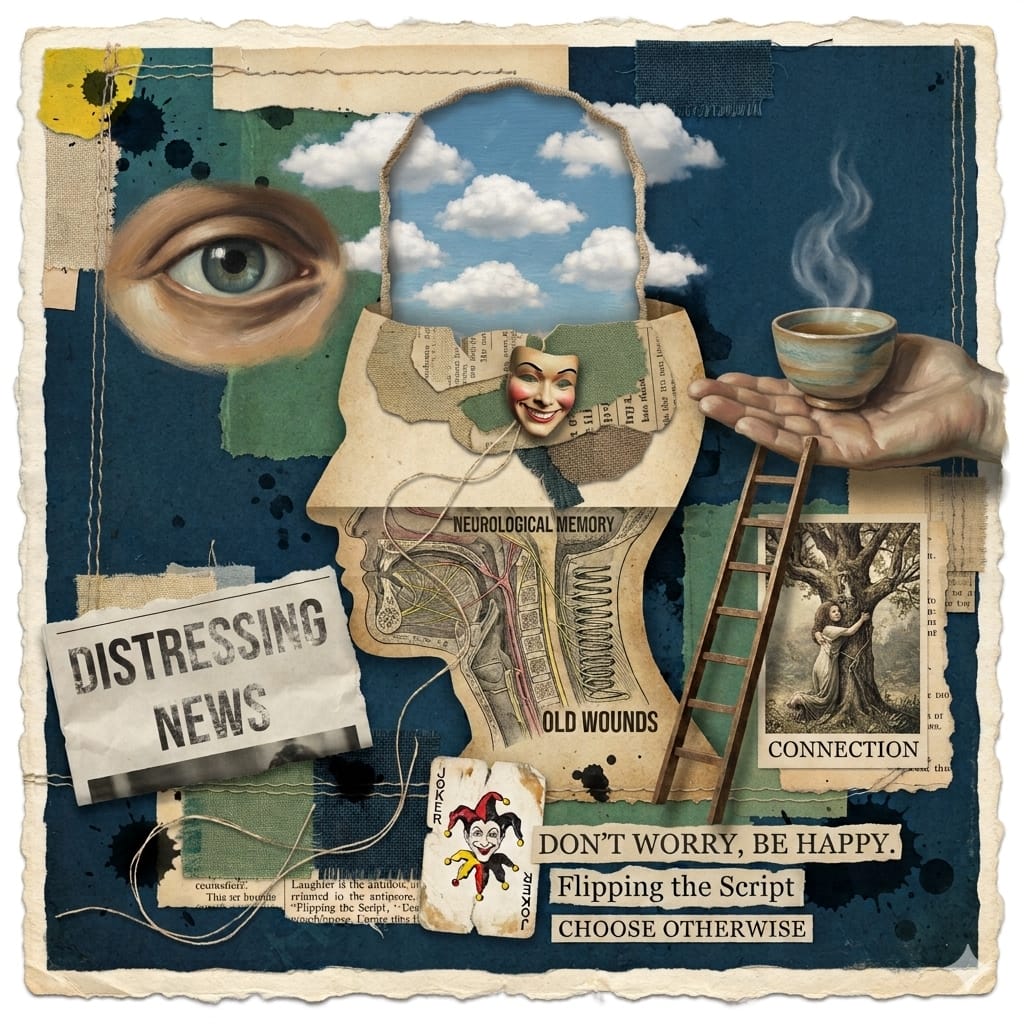
Don't worry, be happy?

It is possible to be happy if we drop worry. Yes. And…no. It’s complicated.
Worry is a pattern, and once we are conscious of that, and only then, can we realize it’s a decision and we can choose otherwise. We can catch ourselves in the act and just…stop. Easier said than done, I know. There are real things in life that we face that can feel scary and are real problems and are truly hard to get through. Where I have found myself struggling a bit is when I don't have any problems, and yet I find myself creating them. Luckily, I have enough self-awareness to catch myself when I'm doing this now. I have to check myself before I wreck myself, because, yes, it's bad for my health. 😃
When I’m cooking, I'll throw on Don’t Worry Be Happy by Bobby McFerrin because it’s a feel-good song, yet there is an undercurrent to the song—the flip side of being happy. When I recently watched the video, as I’m currently on my 80’s music video rampage, this flip side (or underbelly) became apparent. Famous comedian, Robin Williams, who tragically took his own life, stars in the video alongside award-winning performer and mime Bill Irwin and Bobby himself.
In the music video, McFerrin looks at some distressing news in the newspaper and peers over the window ledge; at other sections, his facial expression switches drastically from deadpan to a fake smile as he mouths, “Don’t worry, be happy.” The whole music video is darkly comedic. Comedians are some of the most brilliant among us. I liken them to the Joker card in a deck of cards—they are rare, they stand out, and are the magical archetypes that have found a way to tell the truth to society in a palatable way that makes everyone laugh instead of the alternative (whatever that is).
Laughter is the antidote to depression. Someone is moving funny and it hurts your feelings, don’t worry, be happy. Haha. You lose your job, don’t worry, be happy. Haha. Can't pay your bills, don't worry, be happy. It seems like a trope, and it is, but at the same time it carries valuable wisdom. Could it really be that easy sometimes to just stop worrying and be happy? Well science shows that our thoughts do affect our happiness, so we need to choose wisely.
Sometimes we don’t even know why we are feeling sad or low; sometimes it’s an old neurobiological memory or pathway that’s been lit up too many times, so it’s familiar for our brains, and we don’t know how to get rid of it. Sometimes it's an old wound we haven't addressed that has stayed lodged in our bodies, our neural pathways. Depression is real, it’s serious, and it needs to be addressed.
We can’t always just change it so easily. And sometimes it’s a passing mood like the clouds overhead, but that too, needs to be addressed as soon as possible too so it doesn’t spiral out of control. If we can be aware of these feelings, we can manage them. If they creep up over us and take us by storm without us realizing it, it’s much harder. We can’t fake our way out of depression, but many of us, at times, can fake happiness when we are depressed.
That said, there are tools at our disposal that we can use when we feel sad, angry or depressed—we can call a friend or a family member, drink green tea or coffee, munch on dark chocolate, exercise, spend time in nature, paint, crochet, dance, and well, watch comedy! We can listen to music that calms us, that puts us in a good mood, or rage journal, punch a pillow. We can get in touch with a therapist. We can do something kind for someone or volunteer for those less fortunate. We can do all of the above.
Depression is unexpressed sadness and anger, unexpressed grief that has turned inward instead of expressed outward, often an unconscious pattern we learned when we were young.
To live is to have battle scars. They are unavoidable. Connection, however, is the key—to others, to nature, to ourselves. We can master the art of reframing any situation if we practice (even if it is hard to do at first); to see the silver lining, the hidden blessing, or God working in our lives. And we also have to look at the way we are living and ask ourselves some honest questions such as how can I make my life better, more fulfilling?
On the other hand, the more tough things we go through and grow from, we do learn the deep truth in the Bobby McFerrin’s song lyrics, “Don’t worry, be happy.” Many times, stopping our worrying IS the exact antidote—face our emotions (energy in motion), chill out and just do something pleasurable. If you are facing real problems like a medical diagnosis, real financial problems, abuse, that’s another situation—these real problems can create emotional problems; we need these same tools more than ever. But sometimes our minds linger on problems, therefore creating them, or an unresolved problem from the past still needs to be faced and released, or our desires have caused us frustration as our needs or wishes aren't being met (as the Buddhists say ego-driven desire causes suffering). Feeling negative emotions are helpful, however, as like a warning system, they can let us know something is wrong and it's up to us to investigate what it is to save ourselves.
We can cause our own problems purely from the way we think if we are ruminating, if we struggle with low self-esteem at times, or because literally old emotions are still trapped in our bodies that haven’t been consciously released. I’m a big fan of these trauma-release exercises to physically release stuck energy or holding patterns in the body.
Ever notice when you feel max tension, that's when something makes you laugh so hard that you cry. It's that thin line, that release—the flip side.
Each day is a gift, if we are lucky enough to master our minds, as practice is never perfect, but we can aim to reframe any situation, look at the greater good occurring and free ourselves from our mental prisons with self-love as our guide.
My friend, author, speaker, playwright, Laura Zam, teaches her own framework for using pleasure to bring us back to mindful awareness so we can get back in touch with the ecstatic, natural joy of being alive. She also speaks on college campuses to students about mental health, sexual consent and sexual assault, which is direly important. Right now, she is traveling to visit tea houses across the country in all 50 states and mindfully sipping on delicious teas and striking up conversations with tea house owners, gathering understanding about the power of community.
So sometimes we can just try to just stop worrying and be happy. It's an experiment. Please let me know if that works for you, even if just for just a moment.
Soul-Prompt: What are real problems and what are problems I'm just creating due to rumination? Can I face my emotion or the issue head on, feel all the emotions, and then let go? (maybe in intervals). If not, can I seek out help from a professional who can help me work through it?