Why Metacognition Will Rewire Your Brain...And Your Life

As a second-year master’s student in clinical mental health, we are encouraged to pick a therapeutic approach to specialize in. I believe that most counselors/therapists/healers gravitate to what has worked for them in their own healing journey (teach what you know) or what suits their personality. I’m attracted to a lot of the approaches, but I am particularly drawn to Acceptance and Commitment therapy (ACT). The approach blends metacognition, the ability to observe our thoughts (and bodily sensations), often by practicing mindfulness.
When I was in high school, I used meta-cognition to understand why I was acting so defensive and I came to the conclusion I was afraid of being vulnerable. That realization changed how I showed up and also took accountability—a pivot point in my early emotional life. I was introduced to Buddhism and Taoism in highschool, reading books like Zen Mind, Beginner's Mind and The Tao of Poo as part of my World Religion's class, and my teacher gave us homework, namely to practice mindfulness and to meditate for 15 minutes a day—what a gift that was to learn those skills at an early age!
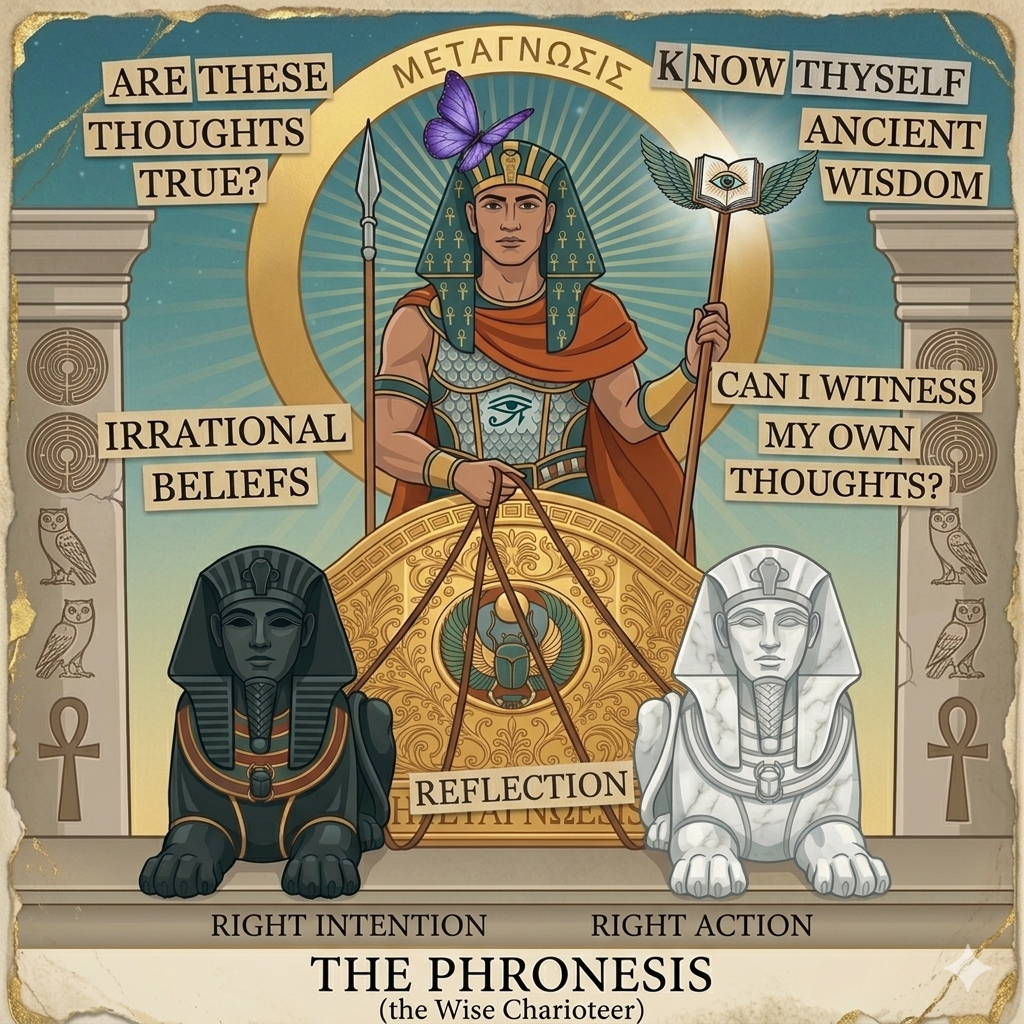
ACT is an evolution of Cognitive Behavioral Therapy (CBT) and Rational Emotive Behavior Therapy (REBT) which essentially trains one to ask oneself: Is this thought or belief I am having rational or true? Is this thought distorted by some emotional lens of mine?
Both approaches encourages us to ask these questions and find a better thought or belief that is kinder to ourselves and more grounded in reality. ACT, however, takes it a step further, and instead of just focusing on using metacognition to identify one's beliefs and then replace them, it asks us to step a back from all of our thoughts and beliefs and observe them as a witness. Remaining in the present moment and witnessing our thoughts creates more psychological flexibility to see our thoughts, beliefs and emotions as separate from the us (the observer), so it doesn't overtake or overwhelm us and we are not deluded into thinking that they are 100% right/reality. This is, in fact, the goal of ACT—to create more psychological flexibility within our own mind and therefore relieve unnecessary distress. It can help us in everyday life, but also if we are experiencing depression, anxiety, PTSD, easting disorders, and even psychosis.
I came across this video on Instagram by Celastrina Becka who mentions that the highest form of intelligence is metacognition. I thought that was an interesting statement. I’m not sure it is true, but it definitely allows us to be more calm, less judgmental and objective. Those who practice metacognition have a leg up at being better stewards of their own minds, emotions and ultimately lives. Those of us who feel more fused with our thoughts and emotions (in essence slaves to them) will essentially have less control and may act and experience our lives accordingly.
Sometimes thoughts arise and that create emotions felt in the body, yet other times emotions rise up instantly as the thought or buried belief behind it remains more subconscious (hence feeling it in the body first).
Plato described this process of mental autonomy in his allegory of the Chariot—for the charioteer must use his reason to move the chariot (self) forward in an orderly manner, using the horse’s reigns to control our two horses—the black horse representing irrational impulses and/or selfish desires and the white horse representing high moral and/or noble impulses. We all have both impulses inside of us and the goal of being in the role of Charioteer is to master them both (and therefore self) through reason. We can use the Socratic Method on ourselves to create more awareness of ourselves and others.
There are many references of the Chariot allegory across world religions such as Hinduism, Christianity, Buddhism, Judaism, Islam, Confucianism and Taoism. Self-awareness and therefore self understanding, and self mastery become the themes.
Personal Example of Meta-Cognition and Cognitive Defusion in Action
I was doing my taxes last week when I realized my driver’s license expired. My shoulders tensed, I felt panic tingle in my body, and I witnessed the judgements that ran though my mind, “How could I let this happen? I’m letting things slide. I’m so not on top of things the way I should be.” I immediately reframed—“Hold up, there’s a solution to this, this is not the end of the world, don’t stress.” Then I focused on my shoulders (which were raised) and allowed them to relax. I took a deep breath. A new thought arose, “Shelley, if you can’t handle this little issue without stress, how will you handle anything more stressful in a calm way?” That had a hint of judgement to it, I admit 😄, but it's intent was instructive, and I witnessed that too. The final litmus test is always, "Would I say that to a freind?" I calmed down further. So often we treat small things like a crisis when they are not. Mindfulness is great practice so that when a real crisis arrives, we have practiced self-control and are better able to handle it.
I found several people talking about metacognition but was particularly struck by Olympian skier Eileen Gu's words (who is 22) on how it helps her.
Steven C. Hayes, who primarily developed ACT, created a workbook that I am finally starting to read , Get Out of Your Mind and Into Your Life.
Some techniques he covers in the workbook are:
Tracking your Thoughts in Time
Watching Bodily Sensations
Just Sitting
Mindfulness eating
You can check out more on his website: https://stevenchayes.com
Soul-Prompt: How often do I step back from my thoughts and witness them as an observer? Can I recognize and accept those feelings AND then actively choose better thoughts and beliefs?
Follow up prompts:
How does that change my experience? My day? My outlook? My life? The choices I make? How I show up in the world?