Narrative Therapy: Rewriting Our Personal Stories

The premise underlying Narrative Therapy is that as humans we use language to make sense of our experiences. We naturally create stories about our personal experiences using language, whether done consciously or subconsciously–it's simply part of our human experience.
This approach to therapy has its roots in constructivist philosophy as well as the sociological work of Emile Durkheim. In college, I read Durkheim's writings on his study of tribal societies and their myths. Myths are by nature ambiguous, often speak to the subconscious, and have their origin in oral tradition of storytelling, passed down through the generations. It's main goal is to make sense of one's experiences in the collective society.
As individuals, we carry our own personal stories to explain our lives. We must naturally question—what stories are we telling ourselves—collectively and individually?
Collectively, we have stories about our group, our country, our world. Individually, we have stories about our childhood and adult lives; often, they intertwine. These stories shape our belief systems and serve as the lens from which we see the world, which subsequently shapes the trajectory of our lives.
Let's look at some examples side by side (and imagine how these stories affect our outlook and decisions in life)
“I believe that life is difficult but we must persevere anyway” or “I believe life is beautiful and every day is a gift”
“I must know what to do next to feel in control" or "If I don’t know what to do, I will always figure it out”
"Love is painful, people always leave” or "Love is beautiful and can last a lifetime"
“Money is hard to come by” or "Money is a form of abundance and there is more than enough to go around"
“I don't feel safe to be seen for who I truly am so I must wear a mask” or "I feel safe to be seen for who I truly am, with all my flaws and vulnerabilities"
Since our thoughts (aka beliefs or stories) whether conscious or hidden in the shadows of our subconscious, create the lens for which we interpret the world, isn't it our duty to self, our very imperative, to look at those beliefs and ask are these necessarily true? And can I create a new narrative based on the experience I would like to have?
What are your stories?
Can you quickly break from this post, grab a piece of paper, and jot down one story you have on the following hot topics: life, family, duty, money, love, trust? Don't think about it, just scribble it down. Be unadulterated, be fast, don't overthink it.
Some of these stories may be negative, neutral or positive, some may be so ingrained you don't actually realize it's your story. Regardless, these stories shape our experience of reality and can act like self-fulfilling prophesies. How you ask? Well, thoughts (otherwise known as "cognitions") create our emotions. Some stories make us feel good, confident, worthy, hopeful, and others make us feel discouraged, sad, unconfident or fearful. The point is we get to choose. But when we aren't aware of the stories that are fueling our decisions and emotions, we are robbed of the opportunity to have more mastery over our experience.
As we think and speak words—they reverberate out into the universe as well as back into ourselves. That meaning shapes our very reality, affecting the quality of our experience, our behavioral decisions and usually end up looping on repeat for the rest of our lives.
Do you want to jump to a new track?
There is a formula. Identify, Analyze, Rewrite.
If we want to change the self-defeating stories, we must first identify them. That’s where journaling can be handy. I know it can feel like a pain, but look at it like a one-off experiment. Once we put pen to paper, the words must flow and often our true feelings come pouring onto the page.
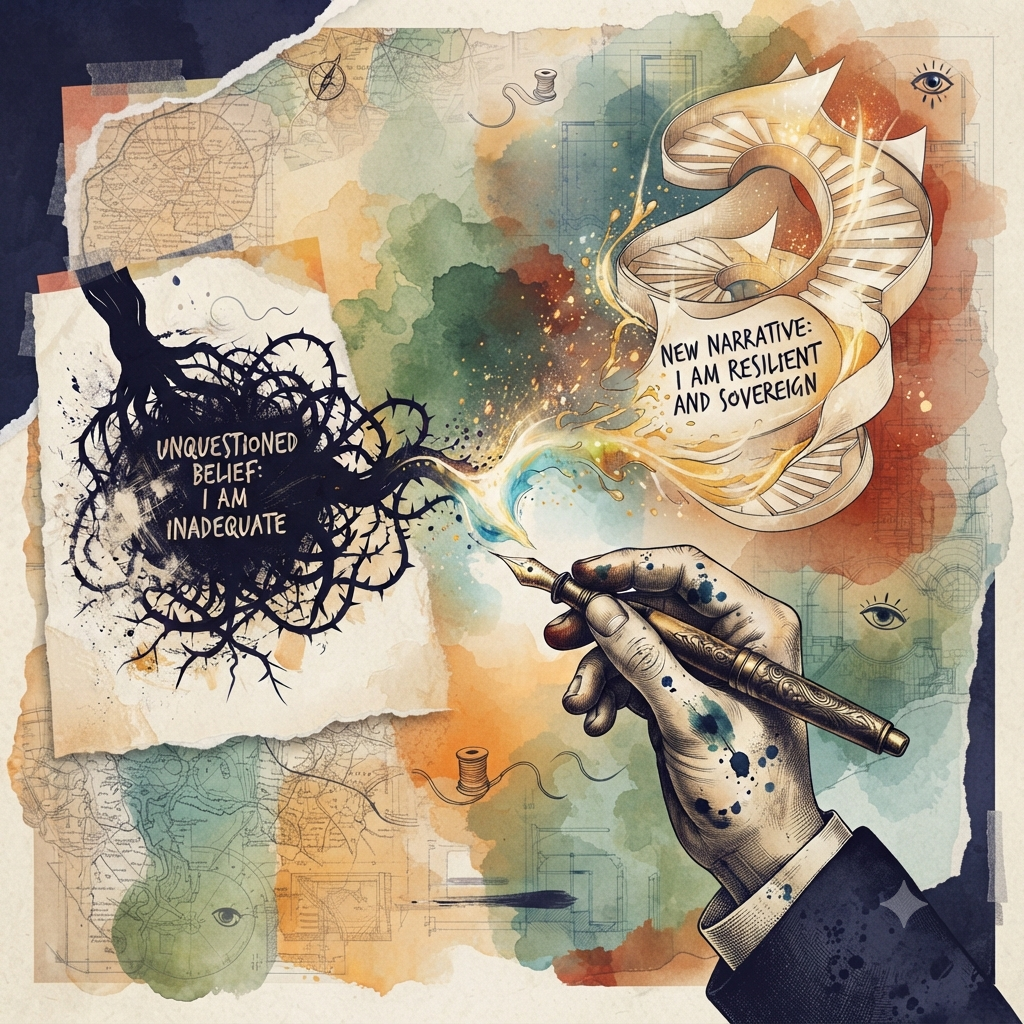
By seeing our stories on paper, we can really look at them. In this process, we also realize we have the power to rewrite them. After all, it's merely a story...and we are the authors.
The next step is to inspect and analyze these beliefs like a detective. Where did they come from? Our parents? Our friends? Our early childhood experiences? Our last relationship?
Finding the origin of a belief can be incredibly powerful as it gives us understanding, and in some cases, hopefully self-compassion.
Once we know the origin, we can ask How are these stories serving me, for better or for worse? What are the effects of these stories in my life?
In this process, too, we begin to see the subjective nature of these thoughts/beliefs/stories as well the realization that we are the narrators with the power to alter these stories at any time.
A narrative therapist can help us separate our self from our stories by asking us to examine any evidence to the contrary. Usually the evidence exists. It can be quite liberating to change your own stories, but first we need space from them. In psychology, creating distance between self and one's thoughts is called psychological flexibility. You don't necessarily need a narrative therapist to do this, however, you can simply sit down and journal, analyze, and rewrite.
This process can give us a chance to step out of our regular lives and look at them from above and more objectively. For instance, we can re-author a story of disaster into a story about our resilience and fortitude. At this stage, we look at exceptions to our beliefs, challenge them, and create a NEW meaning. This can continually evolve. From a better story, we can make better decisions that serve us in a better way. This is not denial of reality, but a frank look at the reality we have created in our inner and outer worlds. How can we drop our old narratives? The truth: somewhat easily once we are aware.
A positive story changes our emotional state. Sometimes, however, our negative emotional patterns, especially if active all of our lives, can be stubborn and spontaneously circle back, just when we thought we've moved on from them. That's where somatic awareness is helpful. When this happens, we can ask ourselves: Is this feeling that descended upon me out of nowhere just a familiar memory of my nervous system? (I remember feeling helpless, depressed, anxious etc.) Can I see it for what it is, allow it to be there, but also remember my new story, and and return to my new default setting in an hour, or the next day?
With awareness, we can recognize negative emotions as just feelings, and breath through it, refocus, rewire, rewrite—and always be kind to ourselves.
Soul-Prompt: What are the stories I tell myself about myself? About my life? Where did they originate? Can I open myself to a new belief that better serves me and the life I want to create?
An article that helped inform this post: Ghavibazou, E., Hosseinian, S., Kivi, H. G., & Ebrahim, N. A. (2021). Narrative Therapy, Applications, and Outcomes: A Systematic Review. Journal of Preventive Counselling, 2(4), 1-11. https://doi.org/10.1177/1541344619847142
If interested, Narrative therapy workbooks can be found on Amazon.