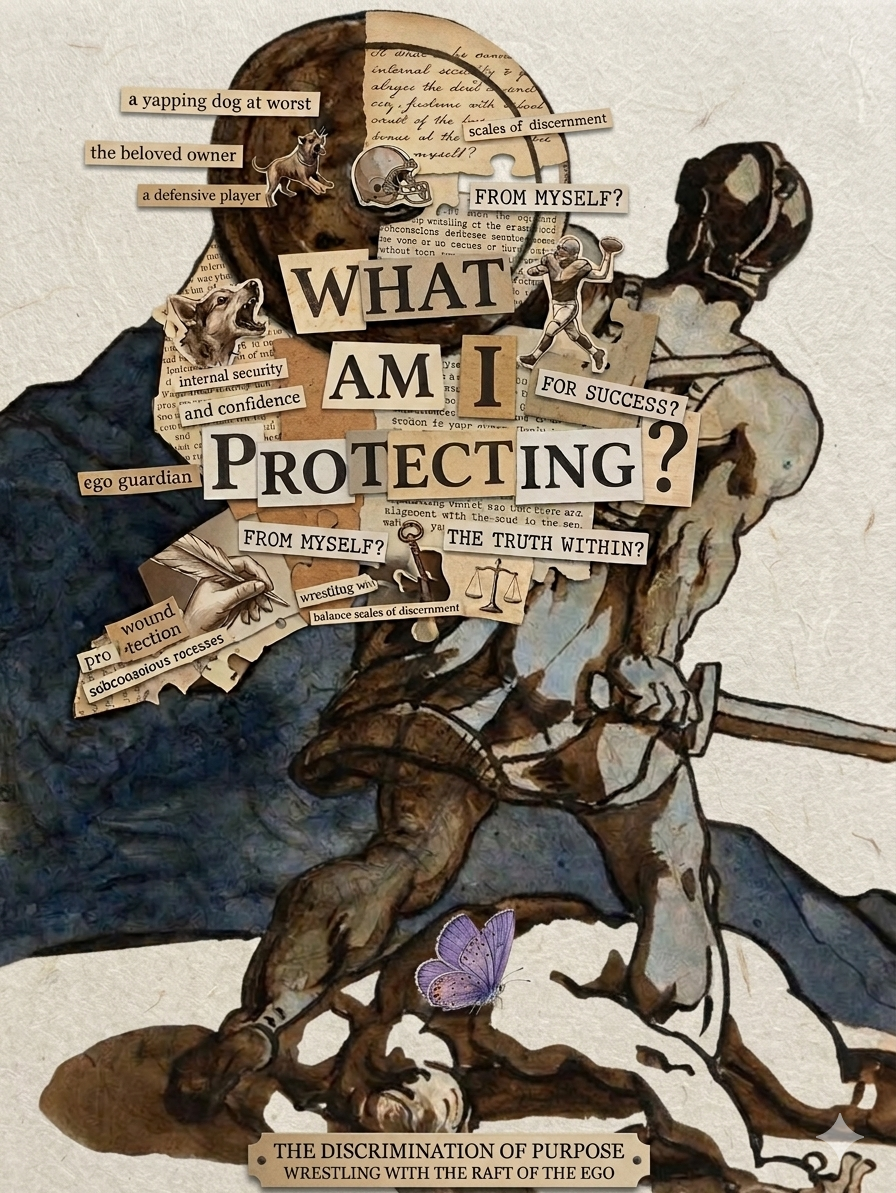
Ego, The Bodyguard To Our Wounded Self

The ego is our defensive lineman to our wounds, our bodyguard who follows us wherever we go, our dog that barks too much at the slightest hint of threat outside. Respectively, the goal is to protect the quarterback so he can play his role successfully, protect the person or protect the dog's beloved owner who takes care of him; it feels like a necessary guardian. But is it?
Can we throw the football, walk in safety alone, or not need the dog to bark at every passing car? Can we feel internal security and confidence, so we don’t need a defensive player at best and a yapping dog at worst.
The notion of the ego is a construct and I'm sure has deeper roots, but Sigmund Freud integrated into a psychoanalytic theory. It’s an interesting framework that most of us in the western world are familiar with, and it doesn’t mean it’s "the truth;" it’s a mere lens too look at how we think and feel. As a human being, I have had the luxury of wrestling with the ego, talking to it, examining it, witnessing it…and befriending it.
While the ego serves a valuable purpose of protecting us, it can cause damage. when it appears, and we witness it, we must ask it calmly and rationally ask, “from what are you protecting me from?” The answer often is in the subconscious, or the recesses of the conscious. Sometimes the answer one finds is a surprise, other times a valid reason. Sometimes the ego doesn’t have an answer right away because t’s trained to fight, “that’s just who I am, that’s all I know,” it says.
An unhealthy or unacknowledged ego can shield us from the truth about others and more importantly about ourselves. Both truths, at times, be too painful, contradictory or complex. We don’t want to know the answer because that means we must face the part of ourselves, the truth within, that the ego’s whole role has been there to service.
We know when our ego is in healthy alignment with our soul, acting as a necessary guardian in a just manner, discernment holds its hand and works in tandem to protect the most beautiful and tender parts of ourselves. We also know when it’s running amuck, out of control, or triggered by old wounds we aren't even aware of, we can instinctually act either like a vicious attack dog or an overthinking monster.
The litmus test is the truth and we can’t know the truth if we don’t ask any questions of our selves and of others. We can use the Socratic Method with ourselves.
Here are a just few examples on an unhealthy ego at work:
I like this person, but I’m afraid they are going to reject me, so I’ll reject them first (a threat to wounded self, I don’t want to be wounded again).
I thought this person agreed with me, and now that they don’t, I must disown them. (they are a threat to my identity, I’m unable to hold opposing views, I feel betrayed).
I feel ignored by this person, and now I take it personally and I must get back at them (a threat to my power, unable to see the other as sovereign, taking it personally, haven’t learned to self-sooth or love the self fully).
A healthy ego instead would not take things personally, would feel okay with space, would not need to “get back,” disown or manipulate anyone. A healthy ego always looks within and asks the question, what’s happening here—within me? And is it justified? (Sometimes it is! And sometimes it isn’t).
And some people’s egos become so hardened, so strong, their inner world’s truth remains impenetrable, literally a black box to themselves; there’s never dialog between the self and its guardian protector. In those cases, the heart can remain closed, and so does the truth (about ourselves). But I believe if we practice self-inquiry on a regular basis, perhaps we can slowly have insight into ourselves. As a friend once said, the two goals in life are self-awareness and authenticity. I have found this statement to be entirely true.
Soul-Prompt: When I’m trying to protect myself, can I ask, what am I protecting myself from? And where did that feeling originate (in childhood or later in life)?